
Feet Killing You After Every Shift? How to Stop Foot Pain From Standing All Day
By The XGRITX Team
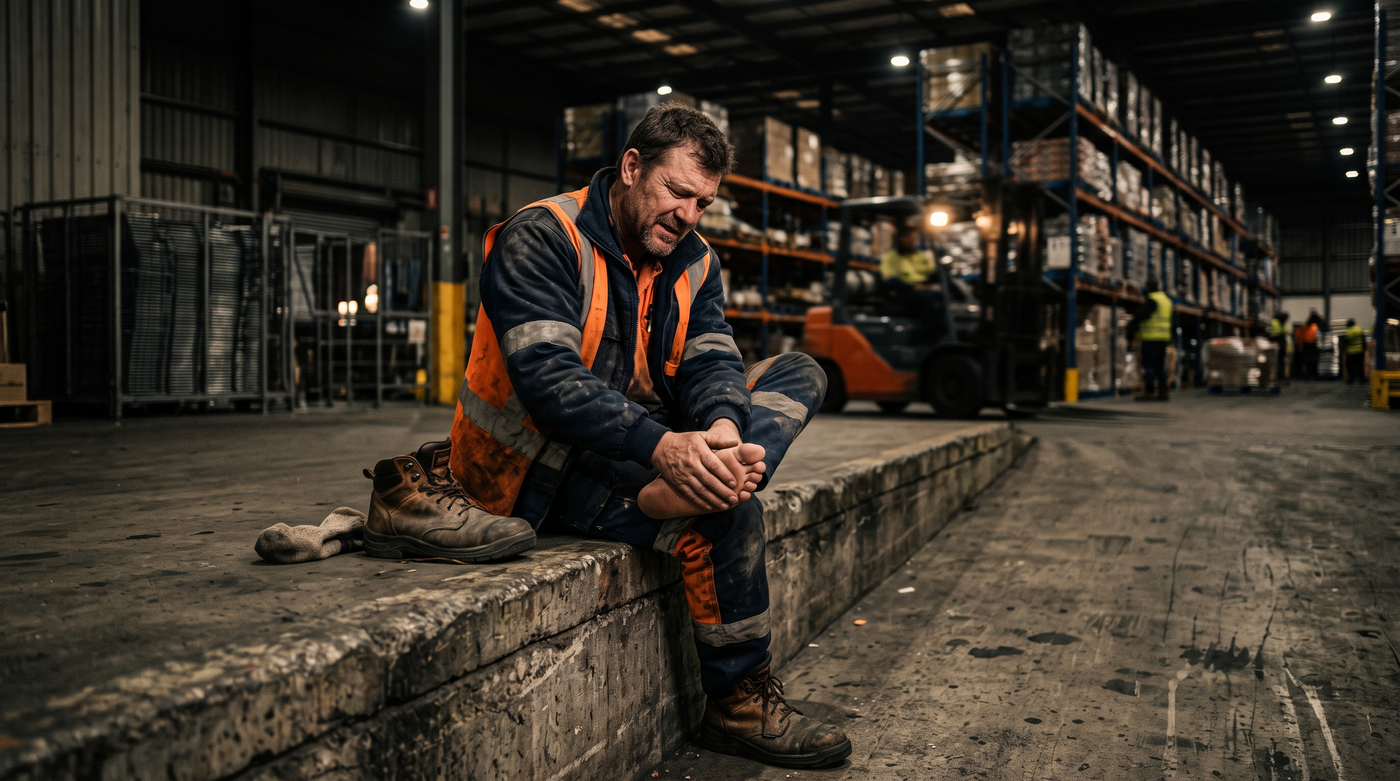
Feet killing you after every shift? If you want to stop foot pain from standing all day, the fastest wins are mechanical, not magic: get into supportive work boots with a firm arch, add a real anti-fatigue insole or floor mat, break up long static standing with small movements, and stretch your calves and arches morning and night. Those are the interventions with the strongest backing. Then you support the recovery side of the equation, hydration, muscle relaxation, and connective-tissue nutrition, so your feet and legs bounce back before the next shift instead of stacking damage day after day.
If your feet hurt after work on concrete, you are not soft and you are not alone. You are standing and walking on one of the least forgiving surfaces there is, for eight to twelve hours, in boots that are usually chosen for toe protection instead of comfort. Here is what is actually happening to your feet, and the plan warehouse and logistics workers use to shut the pain down.

Why do my feet hurt so much after standing all day?
Two things are working against you: the surface and the load. Concrete gives back almost none of the impact you put into it, so every step sends the shock straight up through your heel, arch, and forefoot. Stack that up over a full shift and the small muscles that hold up your arches simply fatigue. According to the CDC and NIOSH, prolonged standing at work is consistently linked to physical fatigue, muscle pain, leg swelling, and low back pain. When your calf muscles stay tensed to keep you upright, they stop pumping blood back up your legs efficiently, which is why your feet and ankles feel swollen and heavy by the end of the day.
The other common culprit is the band of tissue running along the bottom of your foot, the plantar fascia. Cleveland Clinic notes that plantar fasciitis is strongly associated with prolonged standing on hard surfaces like a warehouse floor, and it shows up as sharp heel pain, especially with your first steps in the morning. If that sounds like you, the footwear and stretching fixes below matter even more.
How do I stop foot pain from standing all day at work?
Attack it in layers. No single fix carries the whole load, but stacked together they add up fast. Here is the order that gives you the most relief per dollar and per minute.
| Fix | What it does | Effort |
|---|---|---|
| Supportive work boots | Controls foot motion, spreads load off the heel and arch | One-time buy |
| Firm-arch insoles | Adds arch structure most boots lack, limits overpronation | 5 minutes |
| Anti-fatigue mat | Cushions a fixed station, NIOSH-recognized standing intervention | If you have a set spot |
| Move and shift weight | Keeps the calf pump working, cuts swelling and heaviness | Free, all shift |
| Calf and arch stretches | Loosens the tissue that pulls on your heel | 5 minutes, 2x a day |
| Hydration and recovery | Supports fluid balance and muscle recovery between shifts | Daily habit |
Do work boots and insoles really make a difference?
More than anything else on this list. Shoe inserts are one of the few interventions NIOSH specifically flagged as reducing pain and fatigue from prolonged standing, alongside floor mats. The key detail people miss: pick an insole with a firm arch structure, not just soft foam. A firm arch post under cushioning actually controls how your foot moves and blocks the overpronation that grinds down your arch and heel over a long shift. Soft-only insoles feel nice for an hour and then bottom out.
If you can pick your boots, look for real arch support and a cushioned midsole, and replace them before they pack out. Flat, floppy boots are how a lot of warehouse foot pain starts.

What stretches help feet that hurt after work?
Warehouse work tightens your calves and Achilles, and that tightness pulls on the plantar fascia under your heel. Loosening the back of your leg takes tension off the bottom of your foot. Three that take five minutes total:
- Wall calf stretch: hands on a rack upright, back leg straight, heel down, lean in for 30 seconds each side.
- Stair heel drop: stand on the edge of a step, let your heels sink below the edge, hold 20 to 30 seconds.
- Bottle or ball roll: roll a frozen water bottle or lacrosse ball under your arch for a minute per foot at the end of the shift.
Do them before your first steps in the morning and again when you get home. Consistency beats intensity here.
Can supplements help with foot and leg fatigue?
Supplements will not fix a footwear problem, and no pill cures plantar fasciitis. But once your boots and insoles are handled, the recovery side is where the right nutrition earns its keep. Long shifts on your feet drain fluids and electrolytes through sweat, load your connective tissue, and leave your calves and feet cramping and heavy. That is the gap XGRITX products are built to support, and every one of them is third-party lab tested, made in the USA, and drug-test safe, which matters when your job runs random panels. See our guide on whether your supplements can fail a workplace drug test for the full breakdown.

XGRITX COOLANT
Sweat all shift and your feet and ankles swell as fluid balance slips. A clean electrolyte blend helps you replace what you lose without the sugar load of a sports drink. $34.99.
Shop COOLANT →
XGRITX CLOCK OUT Magnesium Glycinate
275mg of gentle, well-absorbed magnesium glycinate to support muscle relaxation and recovery after a shift on your feet, plus easier wind-down at night. $34.99.
Shop CLOCK OUT

a collagen supplement
Your feet are held together by tendons, ligaments, and fascia. Grass-fed hydrolyzed collagen gives that connective tissue the building blocks it draws on to recover from daily load. $33.90.
Shop the XGRITX lineup →
XGRITX JOINT DUTY Joint Support
The pain rarely stops at your feet. JOINT DUTY pairs MSM, glucosamine, turmeric, and boswellia to support the ankle, knee, and back joints that take the same pounding all shift. $38.99.
Shop JOINT DUTYWhen should I see a doctor about foot pain?
Most standing-related foot pain eases once your footwear, movement, and recovery are dialed in. But see a podiatrist or your doctor if the pain is sharp and localized, does not improve after a few weeks of the fixes above, comes with numbness or swelling in one foot only, or is bad enough that you are changing how you walk. Catching a problem early beats limping through it for months.
Frequently asked questions
Why do my feet hurt after work but feel fine on days off?
Because the trigger is the load, not a lasting injury (yet). Hours of standing on concrete fatigue the small muscles and inflame the tissue under your foot, and a rest day lets it calm down. That relief is a good sign the mechanical fixes here will work, but repeating the cycle without support is how a temporary ache turns into chronic plantar fasciitis.
Do anti-fatigue mats actually work?
Yes, for fixed stations. NIOSH lists floor mats among the recognized ways to reduce standing pain and fatigue. They help most if you work one spot, like a pack station or a line, and less if you are walking miles across a floor, where boots and insoles do the heavy lifting.
Will magnesium stop my foot and leg cramps?
The honest answer is that the research on magnesium for cramps is mixed, and muscle fatigue is often the bigger driver. That said, magnesium supports normal muscle and nerve function and helps a lot of people wind down and recover, so it is a low-risk part of a recovery routine rather than a guaranteed cramp cure.
Does staying hydrated help foot and leg swelling?
Supporting healthy fluid and electrolyte balance helps your body manage the swelling and heaviness that build up over a long shift, especially when you sweat hard in a hot facility. Pair it with moving your feet and calves during the shift so the muscle pump keeps circulation going.
Are XGRITX supplements safe if my job drug tests?
Yes. Every XGRITX product is third-party lab tested, made in the USA, and formulated to be drug-test safe, with no banned stimulants or hidden ingredients. If you want the details on what actually trips a workplace panel, read our post on supplements and workplace drug tests.
Your feet carry you through every shift, so treat them like the equipment they are. Fix the footwear, keep moving, stretch daily, and support recovery with hydration and the right nutrition. Build a stack made for people who work for a living over at Built for the Workday, and remember you can save 20 percent when you grab any two.
These statements have not been evaluated by the Food and Drug Administration. This product is not intended to diagnose, treat, cure, or prevent any disease. This article is for general information and is not medical advice. Talk to a healthcare professional about persistent foot pain.